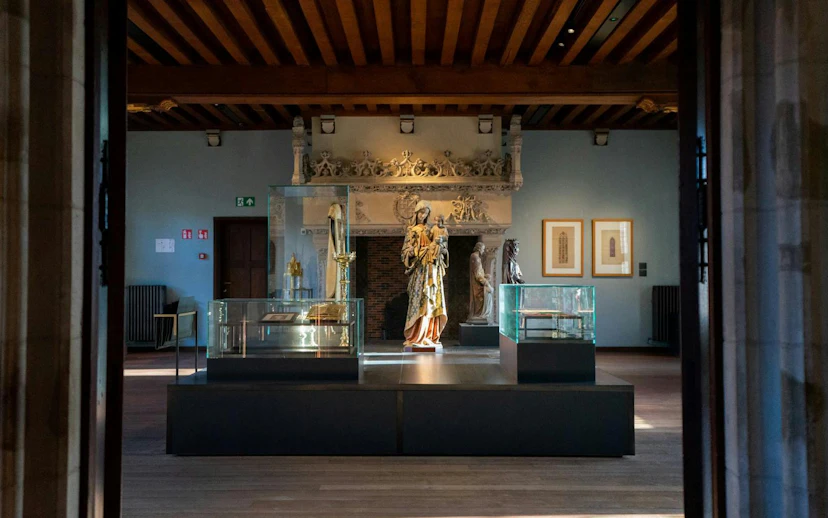
Visiting Gruuthusemuseum in Bruges
Gruuthusemuseum is a historic palace museum best known for turning Bruges' city story into a room-by-room visit inside the former home of the lords of Gruuthuse. This is not a quick walk past a few famous objects: the building itself, its stairs, and its changing interiors are the experience. The visit rewards slow looking more than box-ticking, especially if you understand Louis of Gruuthuse before you reach the private oratory. This guide covers timings, route, tickets, and what to expect on the day.
Quick overview: Gruuthusemuseum at a glance
If you want the short version before you plan the rest of your Bruges day, start here.
- When to visit: Thursday-Tuesday, 9:30am-5pm; closed Wednesday. The first hour after opening is noticeably calmer than 11am-3pm, because most visitors pair it with the Church of Our Lady and use it as a rainy-day stop in the middle of the day.
- Getting in: Standard entry tickets are the simplest way to visit. Weekday walk-ups are often fine, but weekends, school holidays, and rainy afternoons are worth booking at least 2 weeks in advance.
- How long to allow: 1-2 hours for most visitors. Using the full audio content, lingering in the decorative-arts rooms, or pairing it with the Church of Our Lady pushes it closer to 2-3 hours.
- What most people miss: The balcony view, Studio+, and the palace details themselves — fireplaces, woodwork, and room transitions — because many visitors move too quickly between display cases.
- Is a guide worth it? Yes if you want the Burgundian story and room context without relying on your phone; otherwise, the free digital audio guide gives most independent visitors enough structure for less.
Jump to what you need
🕒 Where and when to go
🗓️ How much time do you need?
🗺️ Getting around
🏛️ What to see
♿ Facilities and accessibility
📋 Rules & restrictions
Where and when to go
How do you get to Gruuthusemuseum?
Gruuthusemuseum sits on Dijver in Bruges' historic center, beside the Church of Our Lady and about 8-10 min on foot from Markt and the Belfry.
Dijver 17C, 8000 Bruges, Belgium
- Walk from Markt/Belfry: 8-10 min → follow the historic-center route toward Dijver → easiest if you are already sightseeing in central Bruges.
- Bus: Brugge O.L.V. Kerk stop → short walk → best public transport stop if you are coming from Bruges railway station.
- Taxi/rideshare: Drop-off near O.L.V. Kerk or Pandreitje → 2-5 min walk → simplest option if you want to limit walking before the museum stairs.
- Parking: Pandreitje car park → 7-10 min walk → the most practical paid parking option for central Bruges.
Which entrance should you use?
Check-in happens through the contemporary museum pavilion in the Gruuthuse courtyard, not directly through the palace rooms, and that is what first-time visitors most often get wrong.
- Main entrance: Located at the museum pavilion in the Gruuthuse courtyard off Dijver. Best for all ticket holders. Expect the slowest check-in around late morning on rainy days and holiday weekends.
When is Gruuthusemuseum open?
- Thursday-Tuesday: 9:30am-5pm
- Wednesday: Closed
- Last entry: 4:30pm
When is it busiest? Friday-Sunday, 11am-3pm, plus school holidays, April-September, and December, when central Bruges is fullest and the museum becomes a popular weather-proof stop.
When should you actually go? Arrive at 9:30am or in the final 90 min before closing if you want quieter stairs, more space in the oratory, and a calmer balcony stop.
Because Gruuthusemuseum is central, indoors, and easy to pair with nearby landmarks, rainy late mornings and afternoons can feel busier than dry days even outside summer. If the forecast turns, go right at opening or in the last hour instead.
→ Check the complete Gruuthusemuseum schedule
How much time do you need?
| Visit type | Route | Duration | Walking distance | What you get |
|---|---|---|---|---|
Highlights only | Pavilion check-in → palace model and Louis of Gruuthuse intro → key period rooms → the oratory → balcony | 45–75 min | ~150–200 m | You get the building's atmosphere, the oratory, and the balcony view, but you skip most of the 17th–18th century rooms and the deeper decorative-arts displays. |
Balanced visit | Full room-by-room route through all three historical chapters (Burgundian era, 17th–18th century, 19th-century revival), oratory, balcony, Studio+ | 1–2 hrs | ~300–350 m | This adds the full chronological story of Bruges rather than just the peak moments, plus time to read labels and use the free MB Explorer audio at a normal pace. |
Full exploration | Same full route, with the audio guide used at most or all stops, plus lingering in the tapestry, lace, and manuscript rooms | 2–3 hrs | ~350–400 m | You get the complete narrative depth the museum is built for, though the building is stair-heavy across multiple floors, so this asks more of your stamina than a typical Bruges museum stop. |
You will need around 1-1.5 hours for a satisfying first visit to Gruuthusemuseum. That gives you time for the palace rooms, the private oratory, the main decorative-arts displays, and the balcony view. If you use the full digital audio content or stop carefully in the tapestry, lace, and later-period rooms, you can easily spend closer to 2 hours. Add another 45-60 min if you are pairing it with the Church of Our Lady on the same ticket.
Street vendors and kiosks near Gruuthusemuseum may sell overpriced or invalid tickets. Buy only through the official site or a verified partner to avoid issues at the entrance.
How do you get around Gruuthusemuseum?
Palace layout
Gruuthusemuseum is a multi-level historic-house route rather than a flat gallery loop, so it feels atmospheric but less intuitive than a modern museum. In practice, it is easy to follow if you move steadily, but very easy to rush past entire rooms without realizing how much of the story sits in the architecture.
- Introductory rooms: Palace model, Louis of Gruuthuse, and Bruges' Burgundian rise → budget 10-15 min.
- Historic chambers: Fireplaces, woodwork, household objects, and status displays → budget 15-20 min.
- Private oratory link: The signature space connecting palace and church → budget 10 min, longer if it is busy.
- Upper galleries: Tapestries, lace, stained glass, manuscripts, porcelain, and later-period Bruges material → budget 25-35 min.
- Balcony and Studio+: City view, seating, and a good place to pause before leaving → budget 10-15 min.
Suggested route: Start with Louis of Gruuthuse and the palace model, slow down at the oratory, then give yourself extra time in the upper galleries; many visitors spend too long on early labels and rush the later rooms that explain Bruges beyond the medieval postcard image.
Maps and navigation tools
- Map: On-site orientation and digital interpretation guide the route → pick these up through the pavilion before you enter the palace.
- Signage: Wayfinding is workable, but a downloaded guide or audio route helps because the palace is historic, multi-level, and not arranged like a single straight corridor.
- Audio guide / app: Free digital audio is available in Dutch, French, German, English, Spanish, and Italian → it adds real value if you want context beyond object labels.
- Accessibility formats: Descriptive audio, text versions, tactile stations, and sign-language content make the route easier to follow if standard labels are not enough.
💡 Pro tip: Bring a fully charged phone and wired or Bluetooth headphones — the free audio adds far more than the labels alone, and it helps the collection feel much more coherent from room to room.
Where are the masterpieces inside Gruuthusemuseum?

The Gruuthuse Palace
Era: 15th-century palace with later neo-Gothic layers
The palace is not just the setting — it is the main exhibit. Room size, fireplaces, woodwork, and staircases do as much storytelling as the objects in the cases, especially when the route shifts from Burgundian prestige to later reinventions of Bruges. What many visitors miss is how much the 19th-century neo-Gothic work shapes the atmosphere they remember most.
Where to find it: Start paying attention from the first interior rooms onward; the architecture carries the story through the entire route.
Louis of Gruuthuse's private oratory
Attribute — Type: Late-15th-century private devotional space
This is the museum's most distinctive room and the clearest expression of wealth, status, and private worship in one place. It physically links the palace to the Church of Our Lady and lets you look into the Gothic chancel the way Louis and Margaretha of Borssele once did. What gets missed is how compact it is — pause instead of pushing through, and let the view do the work.
Where to find it: Mid-route, at the point where the palace connects to the Church of Our Lady side of the complex.
Portrait of Louis of Gruuthuse
Attribute — Figure: Burgundian nobleman, courtier, and patron
The portrait is one of the best places to ground the entire visit, because it turns Louis from a name into a person with power, taste, and ambition. His courtly presentation and devotional details make the later rooms easier to read, especially the manuscripts, oratory, and palace interiors. Many visitors move on too fast here and lose the thread that holds the museum together.
Where to find it: Early in the route, near the introductory interpretation around Louis and the palace story.
Tapestries, stained glass, and wooden sculpture
Attribute — Collection type: Decorative and devotional arts
These rooms carry much of the museum's visual weight. The tapestries show just how portable and expensive status could be, while stained glass and carved religious sculpture reveal the technical skill behind Bruges' workshop culture. What visitors often rush past is the lighting itself — it is subdued for conservation, so your eyes need a minute before the details really appear.
Where to find it: In the upper galleries and later collection rooms after the early palace sequence.
Historic lace and Bruges craftsmanship
Attribute — Craft: Textile and lace heritage
The lace displays make more sense when you read them as economic and social history, not just decoration. They help explain how Bruges built, sold, and later marketed craftsmanship as part of its identity. The detail many people miss is that lace here is tied to labor and trade, not only fashion, which gives the rooms much more depth than a quick glance suggests.
Where to find it: In the decorative-arts sections of the main museum route, after the early Burgundian narrative.
The balcony and Studio+
Attribute — Experience type: Viewpoint and reflection space
The balcony gives you one of the best close-range perspectives over the Church of Our Lady precinct, bridges, and surrounding historic core. Studio+ is quieter but just as useful — it is the place to sit, reset, and connect what you have just seen inside with the streets outside. Many visitors leave immediately after the last room and miss both.
Where to find it: At the end of the route, just before you complete the visit and exit.
The oratory gets the emotional focus, so many visitors treat the final rooms as a run-out and miss the balcony and Studio+, which are where the museum reconnects its indoor story with the Bruges outside. Slow down for the last 10 min rather than treating the end of the route as the exit line.
Facilities and accessibility
- 🎟️ Entrance pavilion: Check-in happens in the modern pavilion in the courtyard before you enter the historic palace route.
- 🚻 Restrooms: An adapted toilet is available through the pavilion route with staff assistance.
- 🪑 Seating / rest areas: Resting points are built into the visit, and Studio+ is the best place to sit before leaving.
- 🦯 Walking sticks / folding chairs: Both are available to make the stair-heavy route easier to manage.
- 🎧 Audio guide / interpretation tools: Free digital audio, text versions, tactile stations, and descriptive formats add much more context than labels alone.
- 🧩 Sensory resources: Sensory kits are available, which is unusually thoughtful for a historic-house museum.
- 🤟 Sign-language content: International Sign and Flemish Sign Language formats are available within the interpretation offer.
- ♿ Mobility: Gruuthusemuseum is not wheelchair accessible because the palace has multiple stairs, small level changes, and no visitor lift.
- 👁️ Visual impairments: Descriptive audio and tactile stations are available, and text versions of the audio help if standard label reading is not enough.
- 🧠 Cognitive and sensory needs: Sensory kits and the quieter first and last opening hours make the visit easier, while the oratory bottleneck and narrow stairs can feel more intense at midday.
- 👨👩👧 Families and strollers: Families are welcome, but the route is not pushchair-friendly end to end, so a baby carrier is simpler than a stroller.
- 🤝 Companion support: Companions of visitors who cannot visit independently may enter free.
This works best for children who enjoy real historic spaces, views, and tactile interpretation more than button-heavy interactivity.
- 🕐 Time: 45-75 min is realistic with younger children, and the palace rooms, oratory, and balcony are the best sections to prioritize.
- 🏠 Facilities: Sensory kits, tactile stations, seating points, and the calmer Studio+ ending make the visit easier with children.
- 💡 Engagement: Frame it as a palace visit first and a museum second — looking for fireplaces, staircases, and the church-viewing room works better than trying to read every label.
- 🎒 Logistics: Bring a charged phone, headphones, and as little as possible, because the route includes narrow stairs and frequent level changes.
- 📍 After your visit: The Church of Our Lady is the easiest next stop, because it is immediately beside the museum and adds a very different space without extra travel.
Rules and restrictions
What you need to know before you go
- Entry requirement: Use a valid dated ticket, and bring proof for any reduced fare or museum pass you plan to use.
- Bag policy: Travel light, because the visit runs through historic rooms, narrow stairs, and small level changes rather than wide modern galleries.
- Planning consequence: This works best as one continuous visit, so use the pavilion facilities and set up your audio before you start.
Not allowed
- Food and drink: Keep snacks and drinks for before or after the palace visit rather than carrying them through the historic rooms.
- Smoking and vaping: Step outside the museum precinct if you want a break, because the route itself is fully indoors and compact.
- Pets: Assistance support should be arranged in advance if needed; the museum route is not designed around animal access.
- Touching exhibits: Use the tactile interpretation points and leave historic objects, textiles, and architectural details untouched.
Photography
Personal photos are usually the most practical choice here because the museum route is compact, dimly lit in places, and built around historic interiors rather than open gallery space. The real distinction is not room by room so much as comfort and conservation: flash, bulky gear, and anything that blocks the narrow stairs or the oratory slow the visit for everyone else.
Good to know
- Closure pattern: The museum is closed on Wednesday, which catches out visitors who assume Bruges landmarks all open daily.
- Audio setup: The free digital audio works best on your own phone with your own headphones, so arrive ready rather than trying to sort it out mid-visit.
Practical tips
- Booking and arrival: Book ahead for weekends, school holidays, and rainy afternoons, but regular weekday walk-ups are usually easier; if you want the official private guide, book at least 2 weeks ahead.
- Pacing: Do not burn all your time in the first rooms — save energy for the private oratory, upper decorative-arts galleries, and the final balcony stop, which many visitors rush.
- Crowd management: The best slot here is 9:30am-11am, because central Bruges foot traffic has not fully built yet and the oratory is much easier to enjoy without group bottlenecks.
- What to bring or leave behind: Bring a charged phone and headphones for the free audio, and skip heavy bags if you can because the palace has narrow stairs, small level changes, and no lift.
- Time budgeting: Allow 90 min if you want a solid first visit, 2 hours if you like decorative arts, and a little more if you plan to stop often for photos and audio.
- Weather strategy: This is one of the better wet-weather culture stops in Bruges, which is exactly why it feels fuller on rainy late mornings than some bigger museums do.
What else is worth visiting nearby?
Commonly paired: Church of Our Lady Museum
- Distance: About 100 m — 1-2 min walk
- Why people combine them: They are physically connected by Louis of Gruuthuse's private oratory, so the church feels like the natural second chapter rather than a separate detour.
Commonly paired: Groeningemuseum
- Distance: About 250 m — 3-5 min walk
- Why people combine them: It is the cleanest same-day contrast in central Bruges: Gruuthuse gives you city history and historic-house atmosphere, while Groeningemuseum shifts the focus to Flemish painting.
Also nearby
Museum Sint-Janshospitaal
- Distance: About 300 m — 3-5 min walk
- Worth knowing: It is a strong follow-up if you want more medieval Bruges after Gruuthusemuseum, especially if you prefer a clearer object-and-story structure.
Canal cruise docks near Dijver
- Distance: About 400-600 m — 5-10 min walk
- Worth knowing: A short boat ride is a smart reset after a label-heavy museum visit, and it helps you reconnect the palace story with the city outside.
Eat, shop and stay near Gruuthusemuseum
- On-site: There is no museum café built into the visit, so this works better as a coffee-stop museum or a pre-lunch cultural visit.
- Better options nearby: The streets between Dijver and Markt have the widest spread of cafés and lunch spots within a 5-10 min walk.
- Better options nearby: The Church of Our Lady and Sint-Janshospitaal side of the historic center is the easiest place to eat if you are continuing to another museum afterward.
- Better options nearby: Markt is the simpler choice if you want a larger sit-down meal after finishing the museum route.
- 💡 Pro tip: Eat before 12 noon or after 2pm if you can — Bruges lunch traffic builds faster than the museum crowds do.
Staying near Gruuthusemuseum works very well for a short Bruges trip because you can walk everywhere that matters in the historic core. The trade-off is price: this is one of the most atmospheric and convenient parts of the city, so it is rarely the budget option. If your priority is early museum starts, evening walks, and minimal logistics, it is a strong base.
- Price point: Expect central historic-core pricing, with the best-value exceptions usually a little farther from the busiest postcard streets.
- Best for: Travelers on a short Bruges stay who want to walk to Gruuthusemuseum, the Church of Our Lady, Groeningemuseum, and canal docks without using transport.
- Consider instead: Stay closer to Bruges railway station for lower rates and easier arrivals, or around the quieter Minnewater and Beguinage area if you want a calmer base within walking distance of the center.
Frequently asked questions about visiting Gruuthusemuseum
Most visits take 1-2 hours. If you use the full digital audio content, stop carefully in the tapestry and lace rooms, or pair the museum with the Church of Our Lady right after, you can easily spend closer to 2-3 hours across the visit.
Yes, it's best to book in advance, especially during weekends, school holidays, rainy afternoons, and December, when central Bruges is busier and this museum becomes a popular indoor stop.
Arriving 10-15 min early is enough for most visits. That gives you time to check in through the pavilion, open the free audio on your phone, and start the route without feeling rushed on a museum that works best when you settle in early.
Yes, but bring only what you can comfortably carry through a historic-house route. Gruuthusemuseum has narrow stairs, small level changes, and no lift, so a light day bag is far easier than a bulky backpack if you want the visit to feel smooth.
Personal photos are usually the simplest option here. The main practical limits are low light, tight circulation in the oratory and on the stairs, and being considerate around other visitors, so a phone or small camera is more comfortable than bulky equipment.
Yes, but groups need to plan more carefully here than at a large open museum. Official private museum guides are available for 90-minute visits and are recommended for up to 15 people, while external private guides are not permitted to guide inside the museum.
Yes, if your children like real historic spaces more than highly interactive exhibits. Most families do best with a 45-75 min route focused on the palace rooms, private oratory, and balcony, rather than trying to cover every label and every audio stop.
No, Gruuthusemuseum is not wheelchair accessible. The palace has multiple stairs, small level changes, and no visitor lift, although the museum does offer supportive interpretation formats, resting points, and free entry for companions of visitors who cannot visit independently.
Food is available nearby, but not as part of the museum route itself. The simplest plan is to eat before or after your visit, with plenty of café and lunch options within a 5-10 min walk around Dijver, the Church of Our Lady area, and Markt.
Yes, free digital audio content is available. The standard language offer includes Dutch, French, German, English, Spanish, and Italian, and the museum also stands out for descriptive audio, text versions, tactile interpretation, and sign-language content.