Visiting Historium Bruges: your complete guide
Historium Bruges is an immersive history attraction best known for turning medieval Bruges into a walk-through story with film sets, sound, and virtual reality. The visit is compact rather than museum-sized, but it feels more structured than many people expect because the route is linear and timed add-ons affect your pace. The biggest difference between a rushed visit and a good one is booking the VR and tower together, then saving the tower for clearer weather. This guide covers timing, tickets, arrival, and pacing.
Quick overview: Historium Bruges at a glance
If you want the short version before you book, start here.
- When to visit: Daily from around 10:30am, with Saturday evening hours running later; the first hour after opening or Saturday after 6pm feels calmer than 11:30am–3pm, when Markt foot traffic and combo visitors build at the same time.
- Getting in: From €22 for standard entry. Story + VR from €28. Book ahead for summer weekends, school holidays, and December; quieter weekdays are the only times you can risk showing up without much planning.
- How long to allow: 1.5–2 hours for most visitors. Add extra time if you want the tower in clear weather or plan to linger at the Duvelorium terrace afterward.
- What most people miss: The Waterhalle reconstruction near the end of the Story, and the terrace at Duvelorium, which many visitors leave too late to properly enjoy.
- Is a guide worth it? Usually no — the multilingual audio guide already carries the experience well, but a live guide helps only if you want more historical context than the cinematic story gives you.
🎟️ Story + VR slots for Historium Bruges can fill a few days ahead during summer weekends and December. Lock in your visit before the time you want is gone. See ticket options!
Jump to what you need
🕒 Where and when to go
🗓️ How much time do you need?
🎟️ Which ticket is right for you?
🗺️ Getting around
🎬 What happens inside
♿ Facilities and accessibility
Where and when to go
How do you get to Historium Bruges?
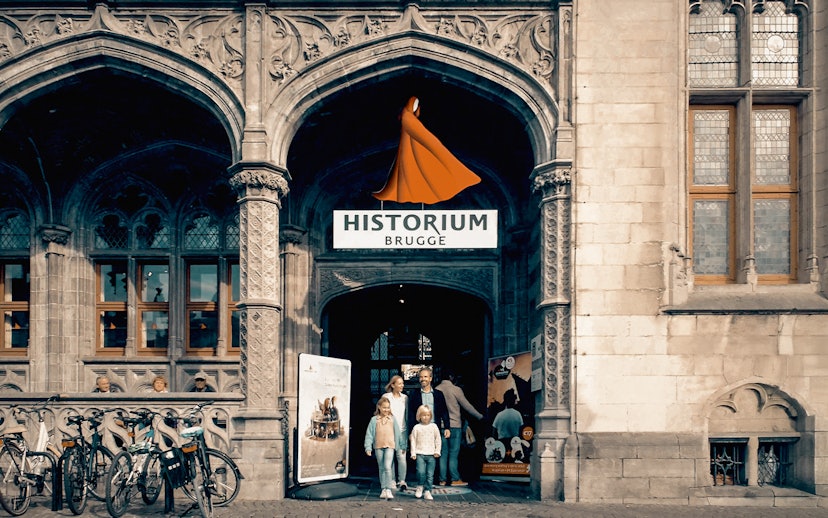
Historium Bruges sits directly on the Markt in Bruges’ historic center, beside the Belfry and about 2km from Bruges station.
Address: Markt 1, Bruges, Belgium
→ Open in Google Maps
- Bus: De Lijn 1 or 2 → Markt stop → 1–2 min walk → easiest option from Bruges station.
- On foot: Bruges station → about 25 min walk → straightforward through the old center if you want to sightsee on the way.
- Bicycle: Bruges station → about 10 min ride → useful if you’re already moving around the city by bike.
- Taxi / rideshare: Drop-off at the edge of the Markt → short walk in → the square itself is pedestrianized.
- Parking: No on-site parking → ’t Pandreitje and Centrum-Station lots are about 5–10 min away on foot.
Which entrance should you use?
Historium is straightforward to enter, but the mistake most visitors make is treating it like a walk-in museum even when they’ve booked timed add-ons.
- Main entrance: Located on the Markt-side frontage. Best for all visitors. Expect 5–15 min wait during late morning in summer weekends and December.
When is Historium Bruges open?
- Monday–Friday and Sunday: Around 10:30am–6pm
- Saturday: Extended evening hours, often later than the standard daytime schedule
- Last Story entry: 1 hour before closing
- Last VR and Tower entry: 30 min before closing
- When is it busiest: Late morning to mid-afternoon in July and August, plus December weekends, when the Markt is at its busiest and timed VR slots fill fastest.
- When should you actually go: The first hour after opening works well for the Story, but Saturday evening is the smartest slot for the full combo because daytime square traffic drops while the attraction stays open later.
How much time do you need?
| Activity | Duration Estimate | Best for |
|---|---|---|
Historium Story | 45 minutes | Core medieval experience |
Historium Story + Virtual Reality | 60 minutes | Balanced visit with popular VR experience |
Which Historium Bruges ticket is best for you
| Ticket type | What's included | Best for | Price range |
|---|---|---|---|
| Historium Bruges Entry Tickets | Entry to the 7-room Story route + exhibition + multilingual audio guide | A shorter visit where you want the core medieval experience and can skip the VR flight | From €21 |
| Historium Bruges Tickets with Virtual Reality Experience | Story route + exhibition + VR flight experience + multilingual audio guide | The most balanced visit when you want the main experience plus the part visitors talk about most afterward | From €26 |
How do you get around Historium Bruges?
Historium Bruges is compact and mostly linear, so you won’t spend time navigating in the usual museum sense. What matters more is knowing which add-on to do when, because the route flows best if you follow the Story first and leave the tower until the weather looks right.
Main areas
- Historium Story rooms: The main seven-room route with sets, projections, and narration → budget 30–45 min.
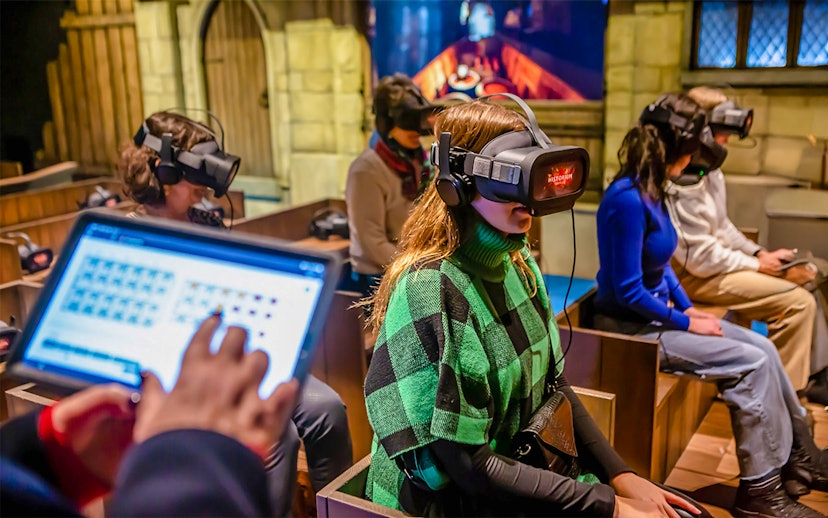
- VR flight area: The medieval Bruges flyover simulation → budget about 10 min, plus any check-in wait for your slot.
- Waterhalle exhibition space: The large reconstructed trading hall near the end of the route → budget 10–15 min if you stop for the details people usually rush.
- Historium Tower (ticket to be purchased separately): The open-air viewpoint reached by stairs → budget 15–20 min, longer if visibility is good and you want photos.
- Duvelorium: The beer bar and terrace stop after the main experience → budget 20–30 min if you want to sit rather than just look.
Maps and navigation tools
- Map: You won’t need a full route map for the Story because it follows a one-way sequence through the rooms from start to finish.
- Signage: Wayfinding is generally enough for the main route, but timed VR and tower add-ons are easier if you confirm the order at check-in.
- Audio guide / app: Multilingual audio narration is built into the experience and adds more value here than wandering through without it.
💡 Pro tip: Do the Story first, then the VR, then decide on the tower once you’ve seen the sky — the tower is the one part of the visit that gets noticeably better or worse with the weather.
Get the Historium Bruges map / audio guide
What happens inside Historium Bruges?

Historium Story
Experience type: Walk-through multimedia story
This is the core of the visit: a narrated journey through seven rooms built around Jacob, the apprentice of Jan van Eyck, and Anna, his classmate. It’s less like a traditional museum and more like a staged medieval Bruges brought to life with projections, sound, and atmosphere. What many visitors rush past is how much context the narration gives each room — if you move too fast, the experience feels thinner than it actually is.
Where to find it: Start at the main Historium entrance on the Markt; this is the first part of the standard route.
The Waterhalle
Historical setting: Reconstructed medieval dock hall
The Waterhalle is one of the most impressive sets in the whole experience, recreating the giant covered warehouse that once stood on the Markt’s canal dock. It matters because it explains why Bruges became wealthy in the first place, not just what the city looked like. Most visitors admire the size of the space and move on, but the trade-story details here are what make the rest of the Golden Age narrative click.
Where to find it: Near the later part of the Story route, after you’ve moved through the main narrative rooms.
Historium Virtual Reality
Experience type: 10-minute VR flight
The VR flight takes you above a reconstructed 15th-century Bruges in a ‘flying carriage’ and is the part of the visit with the highest novelty factor. It turns the city from a story into something spatial — you suddenly see how the waterways, rooftops, and landmarks fit together. What people miss is that it’s not just about the skyline; the smaller alleyways and movement through the city make the medieval layout easier to understand afterward.
Where to find it: In the dedicated VR section booked as part of your timed add-on or combo ticket.
Historium Tower
Viewpoint: 35-m open-air tower
The tower gives you a strong payoff if you’ve just finished the medieval story, because now you’re looking at modern Bruges with the city’s older street plan still visible below. It’s the highest public viewpoint in central Bruges, so photographers get real value here. The detail many people miss is the Belfry framing — spend a minute looking across rather than only down into the Markt.
Where to find it: Adjacent to the main attraction, accessed as a separate tower component or add-on.
Duvelorium
Experience type: Belgian beer bar with terrace
Duvelorium is easy to dismiss as a café stop, but it’s one of the better ways to decompress after the immersive route without fully leaving the setting of the Markt. The terrace view is the real draw, especially if you want a lower-effort panorama after the tower. Many visitors treat it as an afterthought, but if you time it well, this is where the visit becomes less rushed and more enjoyable.
Where to find it: On the first floor of the Historium building, accessible even without museum entry.
Facilities and accessibility
- 🎒 Bags: Bring only a small day bag, because the attraction includes tighter indoor spaces and tower stairs rather than wide museum galleries.
- 🚻 Restrooms: Ticket holders have access to on-site restrooms during the visit, which is useful before the tower climb.
- 🍽️ Duvelorium bar: The first-floor Duvelorium serves Belgian beer and snacks, and it’s worth it mainly for the Markt-facing terrace rather than as a full meal stop.
- 🛍️ Gift shop: The route exits through the shop, so it’s easy to browse souvenirs without doubling back through the attraction.
- 🪑 Seating: The best place to sit down is the Duvelorium bar and terrace rather than the main immersive route itself.
- 📶 Wi-Fi: Free Wi-Fi is available in the Duvelorium bar, which is the most practical place to reconnect after the visit.
- ♿ Mobility: Accessibility is limited rather than fully step-free, because some areas are narrow and the tower requires a stair climb up a tight access route.
- 👁️ Visual impairments: The audio narration helps with context, but this is still a heavily visual experience built around sets, projections, and scene changes.
- 🧠 Cognitive and sensory needs: Expect dark rooms, sound effects, projections, scents, cold air, and occasional water effects, so this may feel intense if you’re sensitive to immersive environments.
- 👨👩👧 Families and strollers: The main experience works better with children who can walk the route comfortably, because tighter passages and the tower are awkward with bulky strollers.
Historium Bruges is usually a better fit for school-age kids than toddlers, especially if they enjoy stories, effects, and interactive visuals more than traditional display cases.
- 🕐 Time: Around 1.5 hours is realistic with children if you focus on the Story and VR, while the tower is the part most likely to slow the visit down.
- 🏠 Facilities: Restrooms on-site and the Duvelorium break afterward make it easier to split the visit into manageable stages.
- 💡 Engagement: Tell kids to look for how Bruges changes between the themed rooms and the VR flight — the comparison keeps them much more engaged than following the plot alone.
- 🎒 Logistics: Bring only a light bag and skip bulky extras, because narrow rooms, darker spaces, and tower stairs make the visit feel more cramped than parents expect.
- 📍 After your visit: Choco-Story is a smart next stop nearby if you want to keep the day kid-friendly after the darker medieval atmosphere here.
Rules and restrictions
What you need to know before you go
- Entry requirement: Tickets are date-specific, and timed online slots are the safest way to avoid disappointment on busy days, especially if you want VR.
- Bag policy: A small bag is the easiest option here, because the route includes narrow spaces and the tower is stair-based rather than luggage-friendly.
- Re-entry policy: Treat this as a one-flow visit, then take your break at Duvelorium afterward instead of planning to step out midway.
Not allowed
- 🚫 Food and drink: Keep drinks and snacks for Duvelorium or after your visit, not inside the immersive Story route or VR section.
- 🚬 Smoking / vaping: Smoke outside before or after your visit rather than expecting space for it inside the attraction.
- 🖐️ Touching sets and props: The rooms are designed to feel close and immersive, but they still work best if you treat the scenery as display rather than hands-on installation.
Photography
- Photography is part of why many people enjoy Historium Bruges, especially in the larger staged rooms, the tower, and at Duvelorium.
- Follow any posted room-by-room instructions as you move through the experience, and keep bulky camera gear to a minimum in the darker, tighter sections so you don’t hold up the flow for everyone behind you.
Good to know
- Atmosphere: Some rooms are dark and slightly eerie, so the experience often lands better with children around age 6 and up than with very young kids.
- Tower timing: The tower is the only part of the visit that really depends on the weather, so save it for the clearest part of your slot if you can.
Practical tips
- Book the right combo: If you’re deciding between tickets, the Story + VR option is the sweet spot for most visitors; the VR adds only about 10 minutes, but it changes the visit more than people expect.
- Don’t leave the tower until the weather looks good: The Story works in any weather, but the tower doesn’t; if the sky is gray when you arrive, do the indoor route first and reassess later.
- Use Saturday evening strategically: Saturday’s longer hours are one of the few times this attraction feels genuinely more relaxed later in the day, because the Markt starts easing off while Historium stays open.
- Be realistic with young kids: The multimedia effects are what make this place good for families, but dark scenes, sound, and tight spaces mean it usually works best from about age 6 upward.
- Keep your bag light: This isn’t a coat-check kind of visit; narrow rooms and tower stairs are much easier with a compact bag than with shopping or luggage.
- Save Duvelorium for the end: It works better as your decompression stop after the Story and VR than as a pre-visit stop, and you’ll enjoy the Markt view more once the route is done.
What else is worth visiting nearby?
Commonly paired: Groeninge Museum
Distance: 350m — 5-min walk
Why people combine them: Historium gives you the cinematic Bruges Golden Age story, and Groeninge follows it with real Flemish paintings and Van Eyck context.
Commonly paired: Belfry of Bruges
Distance: 50m — 1-min walk
Why people combine them: They sit on the same square, so you get the immersive version of medieval Bruges here and the authentic tower climb next door without wasting time crossing the city.
Also nearby
Canal Boat Tour
- Distance: 250m — 3-min walk
- Worth knowing: This is the easiest low-effort contrast to Historium — after the dark indoor story route, the canal view gives you Bruges in daylight and at real street level.
Choco-Story
- Distance: 400m — 5-min walk
- Worth knowing: It’s one of the better family follow-ups if you’re traveling with children who liked the interactive side of Historium but need something lighter afterward.
Eat, shop and stay near Historium Bruges
- On-site: Duvelorium is the easy choice for Belgian beer, drinks, and snacks, and it’s worth it mainly for the terrace view over the Markt rather than for a long sit-down meal.
- Markt cafés: 1–3-min walk, around the square; useful if you want the quickest pre- or post-visit option without adding more walking to your day.
- Burg-area restaurants: 3–5-min walk, toward Burg Square; better if you want a proper lunch or dinner after the visit rather than just a drink with a view.
- 💡 Pro tip: Don’t eat right before your timed slot unless you’re sitting down already — Duvelorium works better after the visit, and summer terrace tables are more appealing once the indoor route is done.
- Historium gift shop: The easiest souvenir stop, because the route naturally exits through it and you can browse without extra detours.
- Markt souvenir shops: Handy for standard Bruges keepsakes if you want something quick before moving on to the Belfry, canal docks, or the rest of the old center.
Yes — if you’re on a short Bruges trip, staying around the Markt or in the historic center makes Historium, the Belfry, canal docks, and evening walks easy on foot. The trade-off is price and crowd level: this is the most convenient part of town, but also the busiest.
- Price point: The area skews mid-range to premium, especially close to the Markt, with better value usually appearing a little farther from the square.
- Best for: Short stays, first-time Bruges visits, and travelers who want to walk everywhere without relying on buses or taxis.
- Consider instead: Stay near Bruges station for better transport convenience and usually better value, or in a quieter old-town edge neighborhood if you want evenings that feel less crowded than the Markt.
Frequently asked questions about visiting Historium Bruges
Most visits take 1.5–2 hours. That usually covers the seven-room Story route, the 10-minute VR flight, and the tower if you’ve booked it, while a quicker Story-only visit can be done in about 45 minutes to 1 hour.
Yes, it’s smart to book ahead if you want a specific time or the VR included. Summer weekends, school holidays, and December are the times when timed slots matter most, while a quiet weekday gives you more flexibility.
Yes, timed entry is worth it on busy days because it removes most of the uncertainty rather than saving a huge physical queue. This matters most if you want the VR flight, since capacity is limited and the best slots go first.
Arrive about 10–15 minutes early. That gives you enough time to check in, sort out any VR or tower timing, and start the linear route without feeling rushed from the first room.
Yes, but keep it small. The attraction includes tighter indoor spaces, and the tower is stair-based, so a compact day bag is much easier to manage than shopping bags or anything bulky.
Yes, but follow any posted area-specific instructions as you move through the experience. The darker rooms, projections, VR section, and tower all work differently, so it’s better to treat photography as allowed unless signage tells you otherwise.
Yes, groups can visit, but booking ahead matters more when you’re trying to keep everyone on the same VR and tower timing. Smaller groups move through the immersive rooms more easily, while larger groups benefit from arriving early and keeping the schedule simple.
Yes, especially for children around age 6 and up. Families usually like the projections, effects, and VR more than they would a traditional museum, but very young children can find some darker scenes and tighter spaces unsettling.
Accessibility is limited rather than fully step-free. The tower is not a good fit for many visitors with mobility needs, and the attraction includes narrow areas, so it’s worth checking your specific access needs before booking.
Yes. The easiest on-site option is Duvelorium, the beer bar inside the building, and the Markt has plenty of nearby cafés within a few minutes on foot if you want a fuller meal after the visit.
The VR flight is a separate 10-minute medieval Bruges simulation, and yes, you can skip it. The main Story still works on its own, but the VR is the add-on most visitors remember best because it turns the city story into something spatial and immediate.
Yes, because it gives you a completely different experience. The Belfry is about the authentic tower climb and view, while Historium is about immersive storytelling, film sets, the VR flight, and a more interpretive way to understand Bruges’ Golden Age.